Readers searching for perchance ai may also be comparing text-to-video tools. This review examines what Higgsfield and Kyncept delivered from the same prompt, including clip length and credits; it does not test perchance ai.
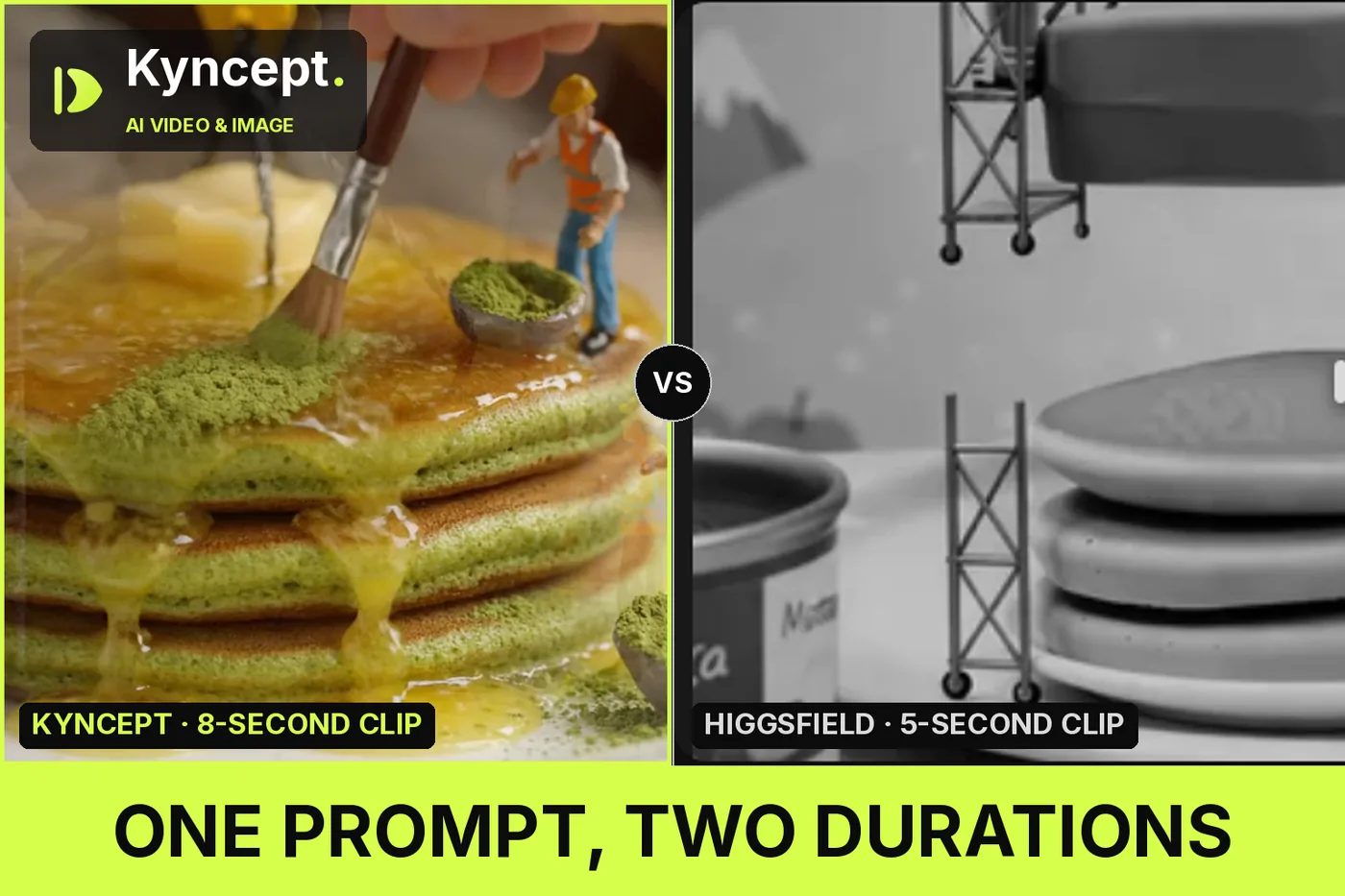
Higgsfield and Kyncept both made video from the same text-only matcha-pancake prompt. Higgsfield delivered five seconds from a request for eight; Kyncept delivered eight.
Independent review: both products were run on my own accounts — a free tier and a paid plan — with no vendor-provided access.
My verdict in 60 seconds
Higgsfield succeeded: the selected Wan 2.5 Fast setting accepted an eight-second text prompt and returned a playable 5.042-second MP4. Kyncept Plus returned two different 8.000-second MP4s from exactly the same video text. The gap is the duration selected on the Higgsfield page, not a failed Higgsfield generation. The following eight-dimension scorecard describes this narrow job only, not either company's whole catalogue:
- Prompt-only completion — Higgsfield: one completed video from one submission; Kyncept: two completed videos from two submissions. No long-run success rate follows.
- Requested versus delivered length — Higgsfield: eight seconds requested, five selected, 5.042 in the file; Kyncept: eight selected, 8.000 in both files.
- Input burden — Higgsfield and Kyncept: text alone, without supplied photo or start/end frames.
- Video debit — Higgsfield: nine credits, 10 → 1 on its free video account; Kyncept: ten credits per clip, 309 → 299 → 289 on its different account.
- File specifications — Higgsfield: one 1904×1104 H.264/AAC MP4; Kyncept: two 1280×720 H.264/AAC MP4s. Pixels are not a quality score.
- Audio-track presence — Higgsfield and Kyncept: AAC stereo with measured non-silent peaks.
- Sound correctness and sync — Unverified for both. No one listened and checked whether the requested sounds matched the actions or whether speech/music was absent.
- Repeatability and exact speed — Unverified as platform scores. Higgsfield has only one completed video; Kyncept's first video lacks a reliable UI completion time.
For an eight-second single file in this setup, I would try Kyncept at https://kyncept.com first. If five seconds will do, Higgsfield is viable here.
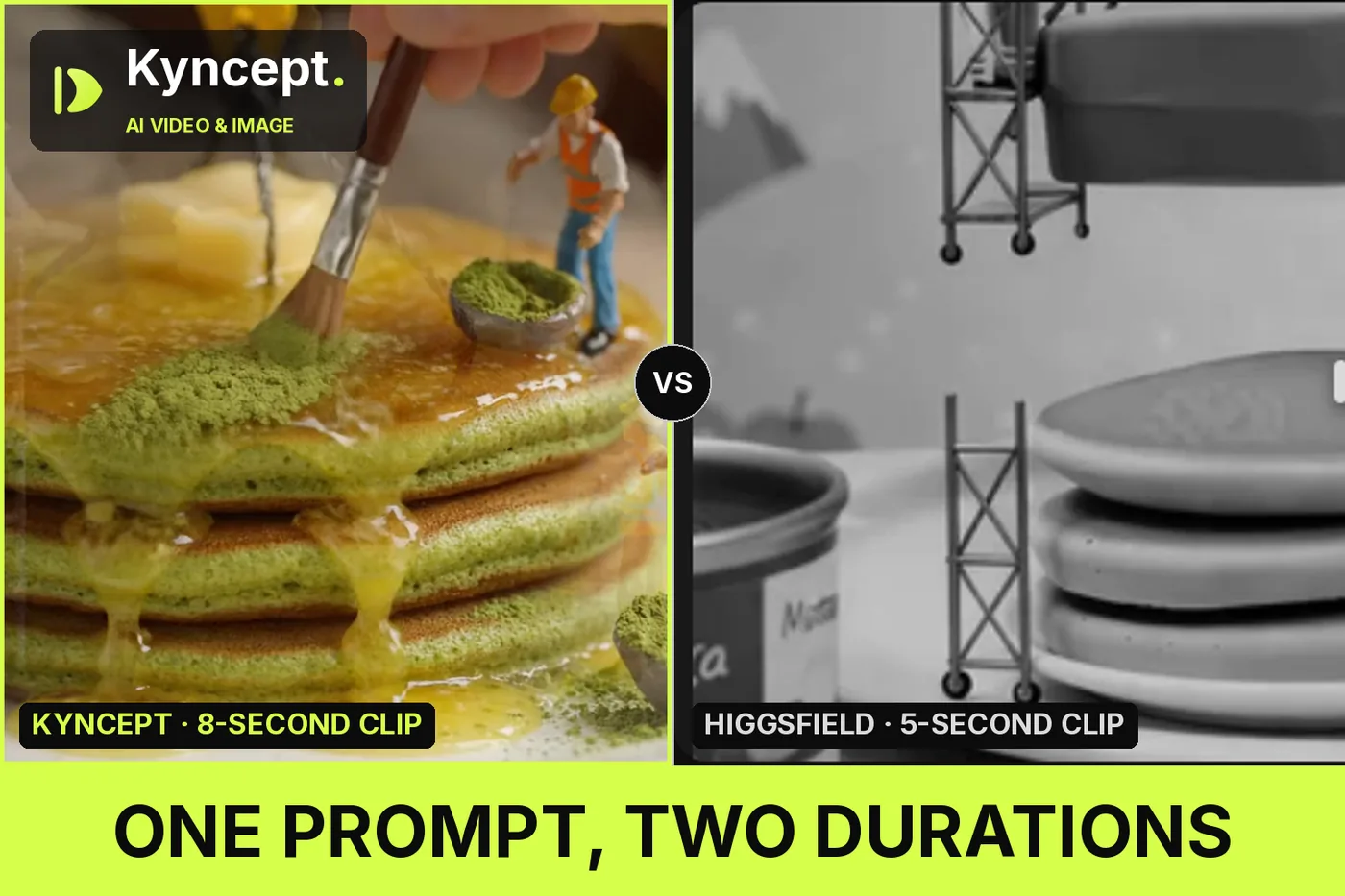
Cover assembled from a genuine Kyncept video frame and the Higgsfield result screen. The eight-second and five-second labels reflect the tested outputs.
One prompt, no photo: what was actually tested
A social miniature-food scene inspired the idea, but that source used a photo-plus-video workflow. It does not establish text-only capability. For this comparison, original text was submitted on both video pages without a source picture or start/end frame; both pages had 16:9 selected. Higgsfield's tested video mode was Wan 2.5 Fast, Enhance off; Kyncept's public video mode was Kyncept Plus. This is one Higgsfield video model, not a sweep of free options or a test of a paid eight-second mode. Here is the identical video prompt:
Create an 8-second 16:9 text-to-video macro shot of tiny bakers building a giant three-layer matcha pancake on a white plate. A yellow miniature crane lowers a green pancake slab; two orange-uniformed workers steady it from scaffolding; a third brushes matcha onto the top. Butter melts and drips down the near edge as steam rises. Audible pulley creak, scaffold taps, powder brushing and a soft butter sizzle synchronized to the actions; no speech or music.
The prompt asks for eight seconds, yet words in a prompt do not override a duration selected in a UI. Higgsfield's homepage is https://higgsfield.ai; the evidence here is the recorded submission, not a claim copied from the homepage.
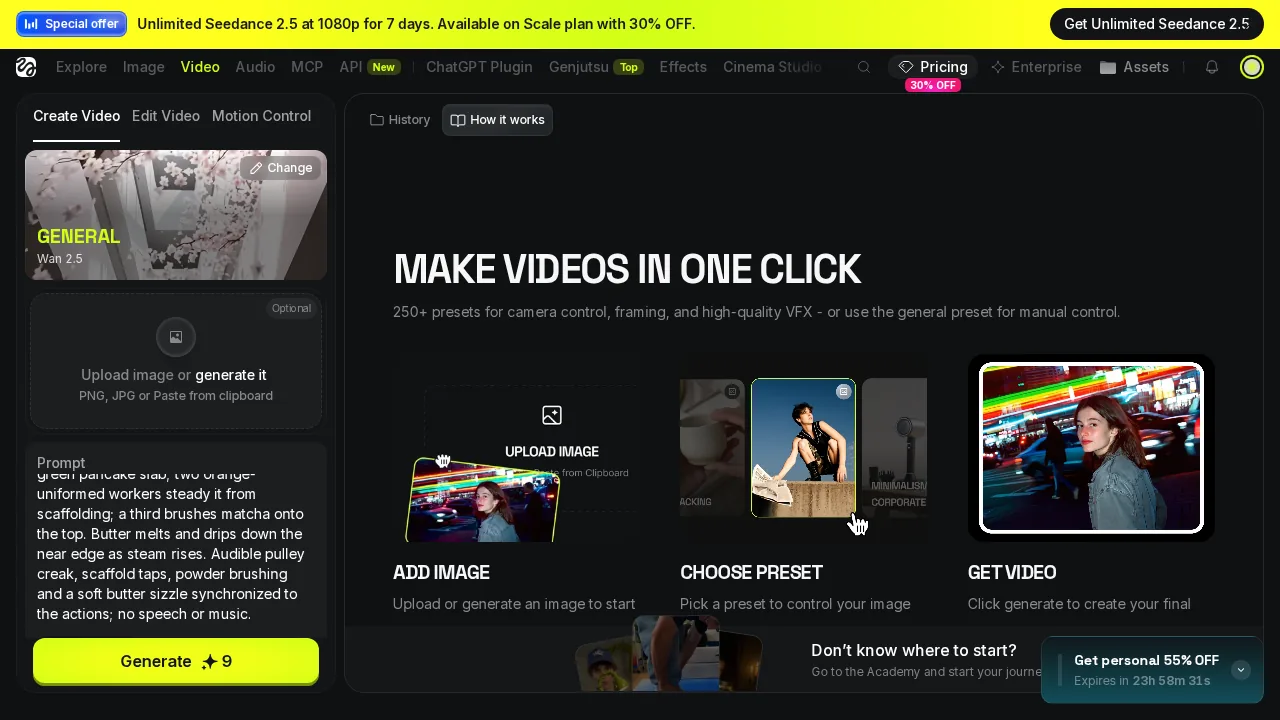
The actual Higgsfield Wan text prompt and nine-credit Generate control. A promotional element in this screenshot is not a measured count of session-wide upsells.
The Higgsfield setting: five seconds for nine credits
On Higgsfield I selected five seconds, 720p, 16:9, with Enhance turned off before submission. The Higgsfield free video account had ten credits and the button showed nine. A different Higgsfield free account was used for images elsewhere in this series: its balance must not be combined with the video wallet. Kyncept video work used an existing account with 309 credits after its image runs, not a matching ten-credit free wallet. Accordingly, two Kyncept video attempts versus one Higgsfield attempt say nothing about the relative generosity of their free tiers.
Higgsfield offered the selected five-second route and charged for that route. An eight-second request did not turn it into an eight-second setting. I did not try every other Higgsfield free model, so I cannot claim this was the longest length available across the service.
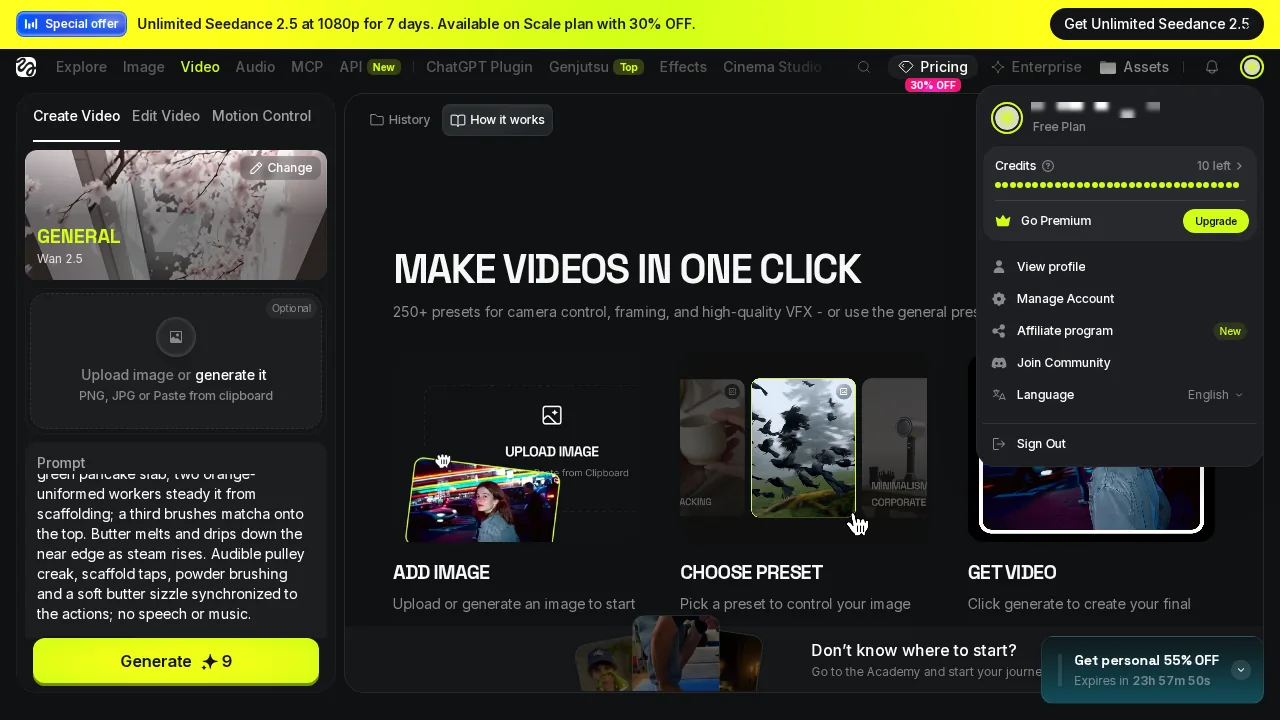
Ten credits on the specific Higgsfield video account, before its nine-credit job. The Higgsfield image account is separate.
Higgsfield returned a video, not a failure screen
Higgsfield showed the selected Wan job processing and later returned an actual clip. A low-credit notification appeared while a nine-credit job was running against ten starting credits; the screenshot alone does not prove a false warning. The wallet subsequently displayed one credit, matching a nine-credit debit. No failed Higgsfield video job is part of this matcha case.
The Higgsfield result was first seen by 127.05 seconds after the click. That is an upper observation bound, not a precise completion time: Higgsfield may have finished between checks. The downloaded MP4 is 5.042 seconds, 1904×1104 pixels, 7,361,121 bytes, H.264 at 24 fps with AAC stereo at 44.1 kHz. Its measured audio peak is non-silent at −0.8 dB; a waveform peak cannot tell which sound played.
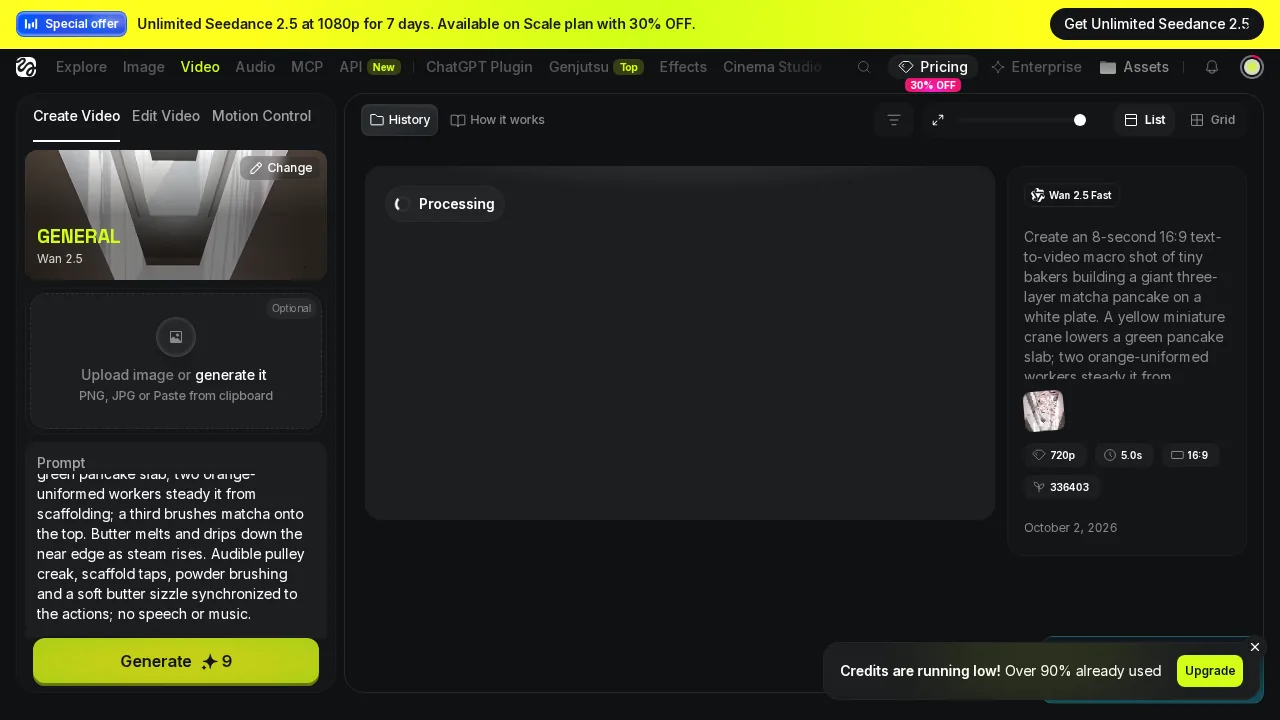
The Higgsfield job processing at the chosen five seconds, 720p and 16:9. A low-credit notice is visible during this nine-credit run.
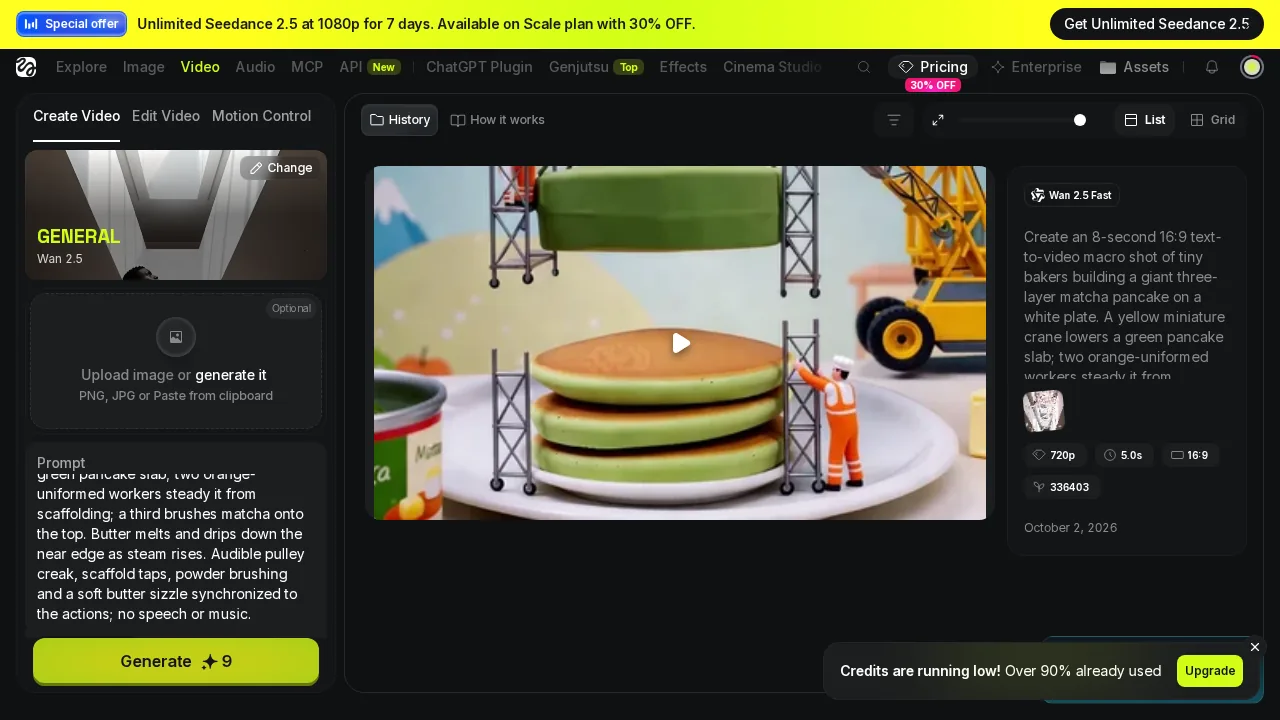
Genuine Higgsfield result screen. The downloaded file, rather than the preview alone, establishes 5.042 seconds.
What five seconds of Higgsfield footage contain
Four sampled frames from the Higgsfield file show a matcha-pancake construction setting, workers, equipment, an outsized brush and yellow liquid. Higgsfield therefore made something relevant to the text-only brief. Yet the workers in the Higgsfield frames wear white chef caps, not uniformly yellow hard hats as specified. The large brush changes the miniature scale. Yellow liquid being visible does not prove the butter melted and dripped at the requested moment; four frames do not establish whether the crane lowered the slab smoothly through the whole clip.
The five-second Higgsfield output also cannot be scored against an eight-second Kyncept clip as though both had equal room for every action. The Higgsfield page selected 720p and 16:9, while the download is 1904×1104, about 1.725:1 rather than mathematically exact 16:9. Kyncept's 1280×720 files are exact 16:9. Those measurements describe files, not hidden processing or an objective sharpness winner.

Four times sampled from the Higgsfield video. These frames support visible scene observations, not a judgment on motion between them or sound correctness.
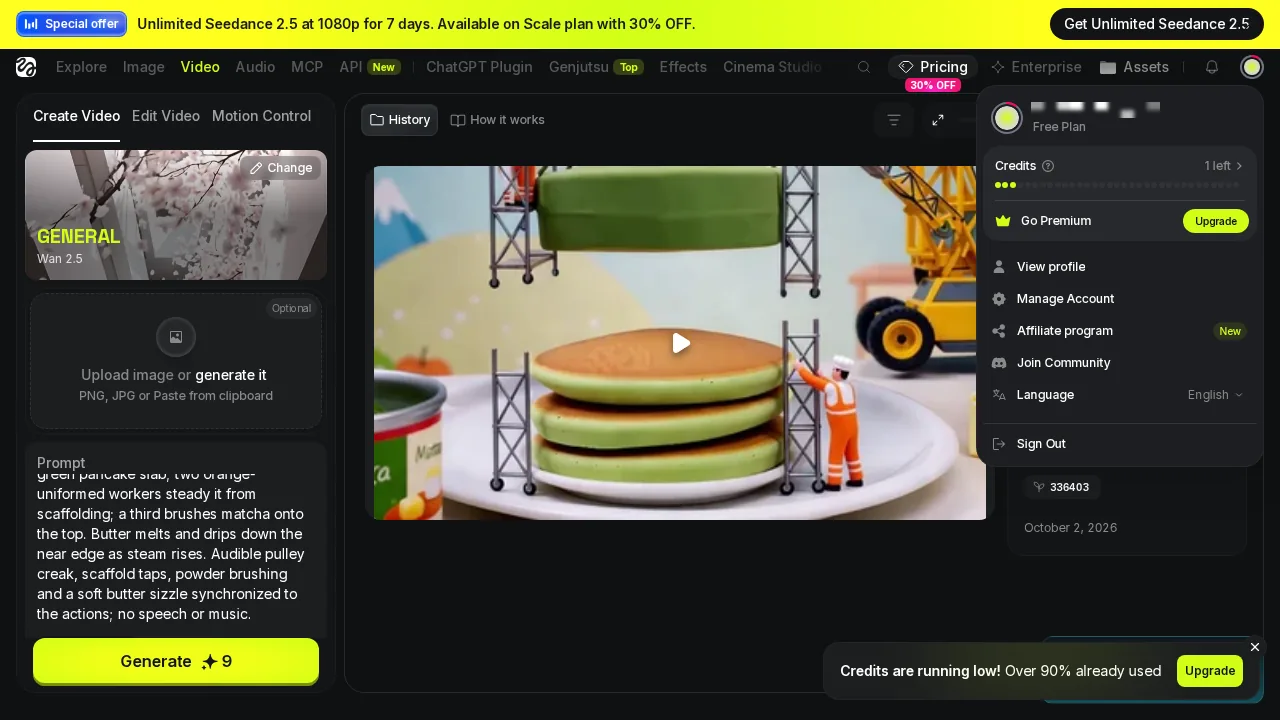
The Higgsfield video wallet after success: 10 → 1. One remaining credit was insufficient for another identical nine-credit job.
Kyncept's first eight-second file: duration known, time unknown
On Kyncept Plus, the same video text and 16:9 choice led to a ten-credit Generate control. The Kyncept balance moved 309 → 299, and the first downloadable MP4 measures 8.000 seconds, 1280×720, 2,485,222 bytes, H.264 at 24 fps with AAC stereo. Its measured audio peak is −9.2 dB, confirming non-silence but not a specific pulley creak or butter sizzle.
The first Kyncept completion has no reliable UI duration. An earlier monitor malfunctioned; I have excluded its reading instead of calling it generation latency. That missing measurement prevents a credible first-clip speed victory over Higgsfield's first-observed upper bound. Both outputs completed, with different file lengths; only one has a trustworthy Kyncept UI clock.
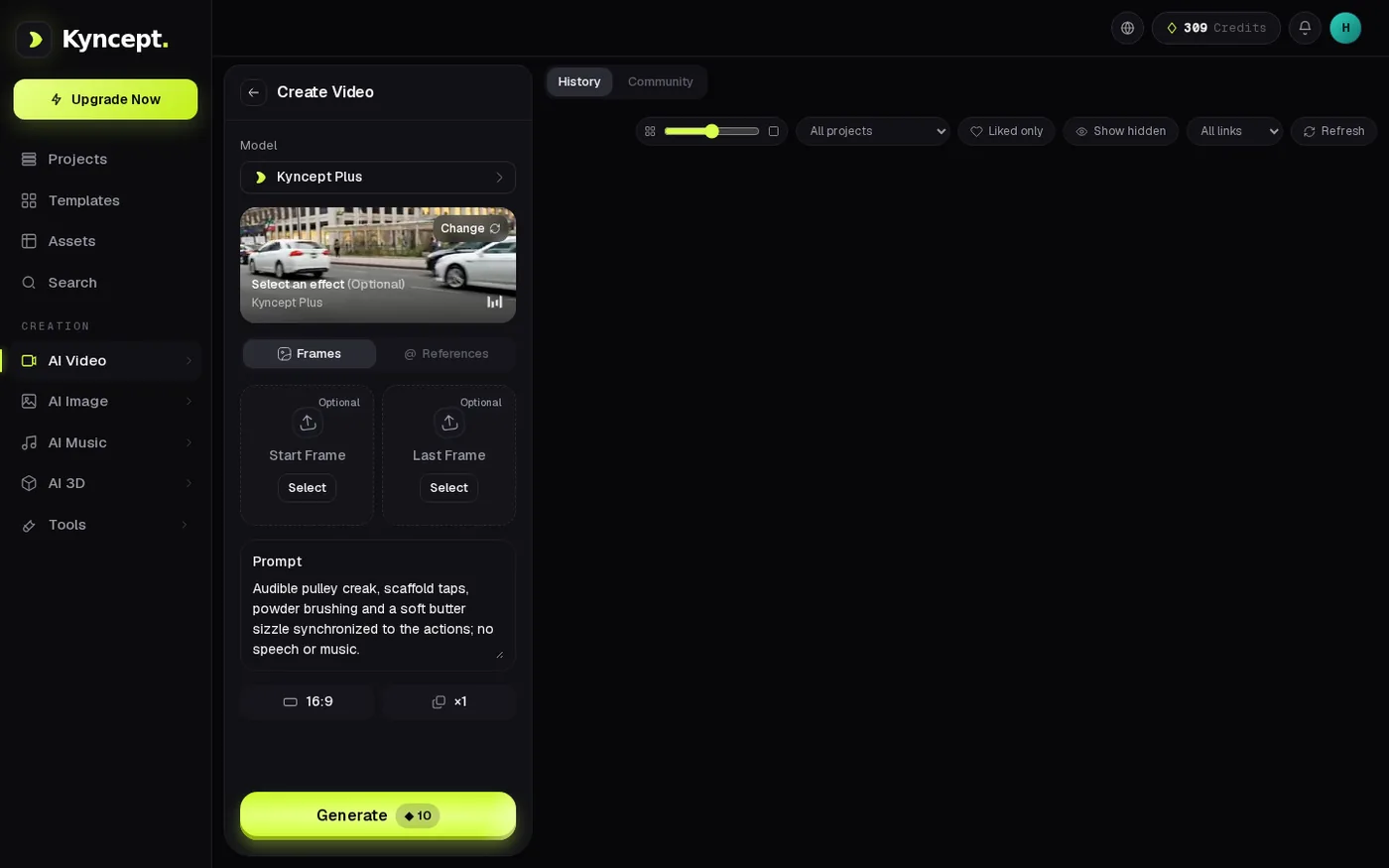
Kyncept Plus before submission: text-only entry, 309 credits, ten-credit button. This was not a comparable Kyncept free account.
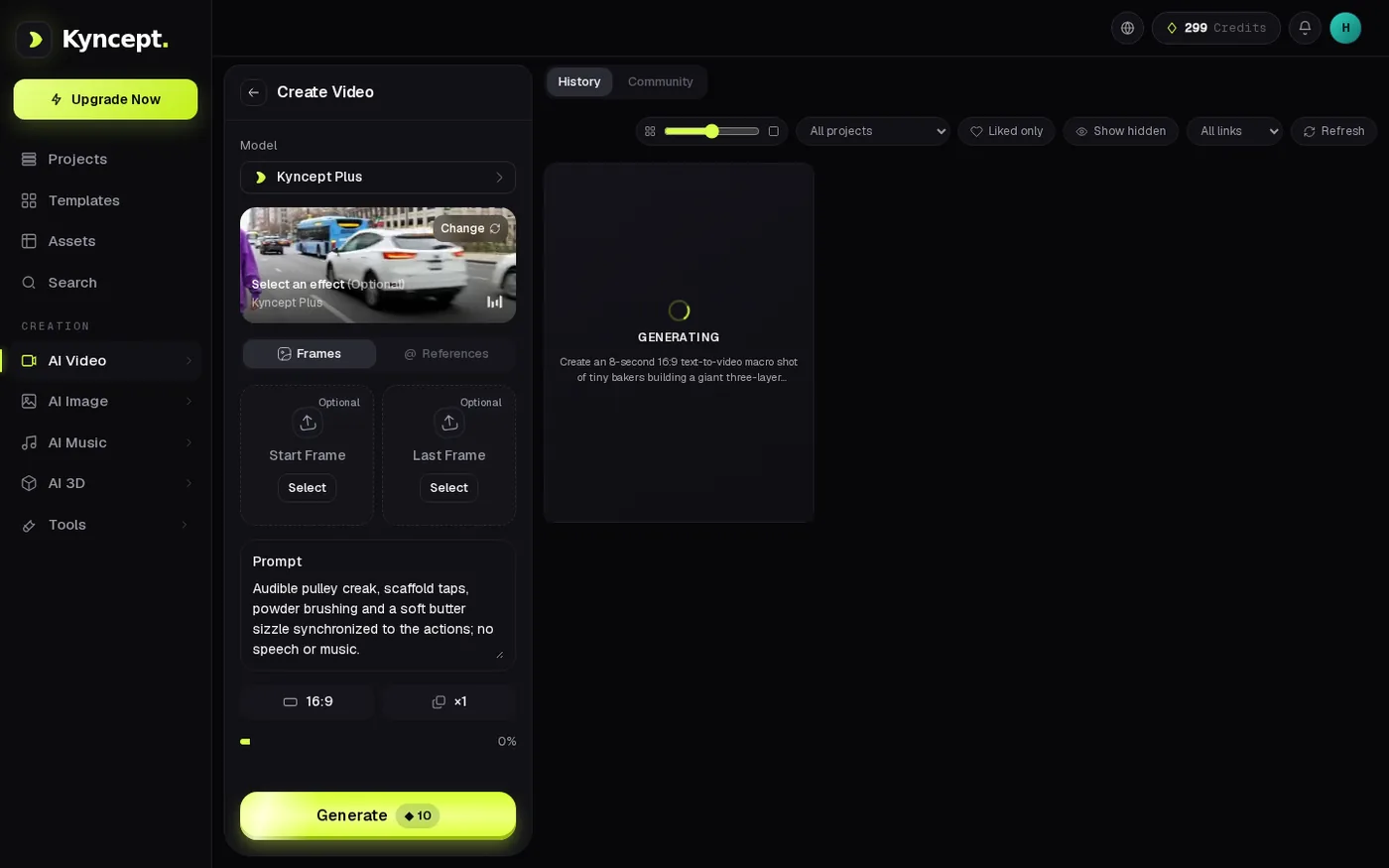
Kyncept processing at 299 credits. This running view proves a submitted job, not its final completion time.
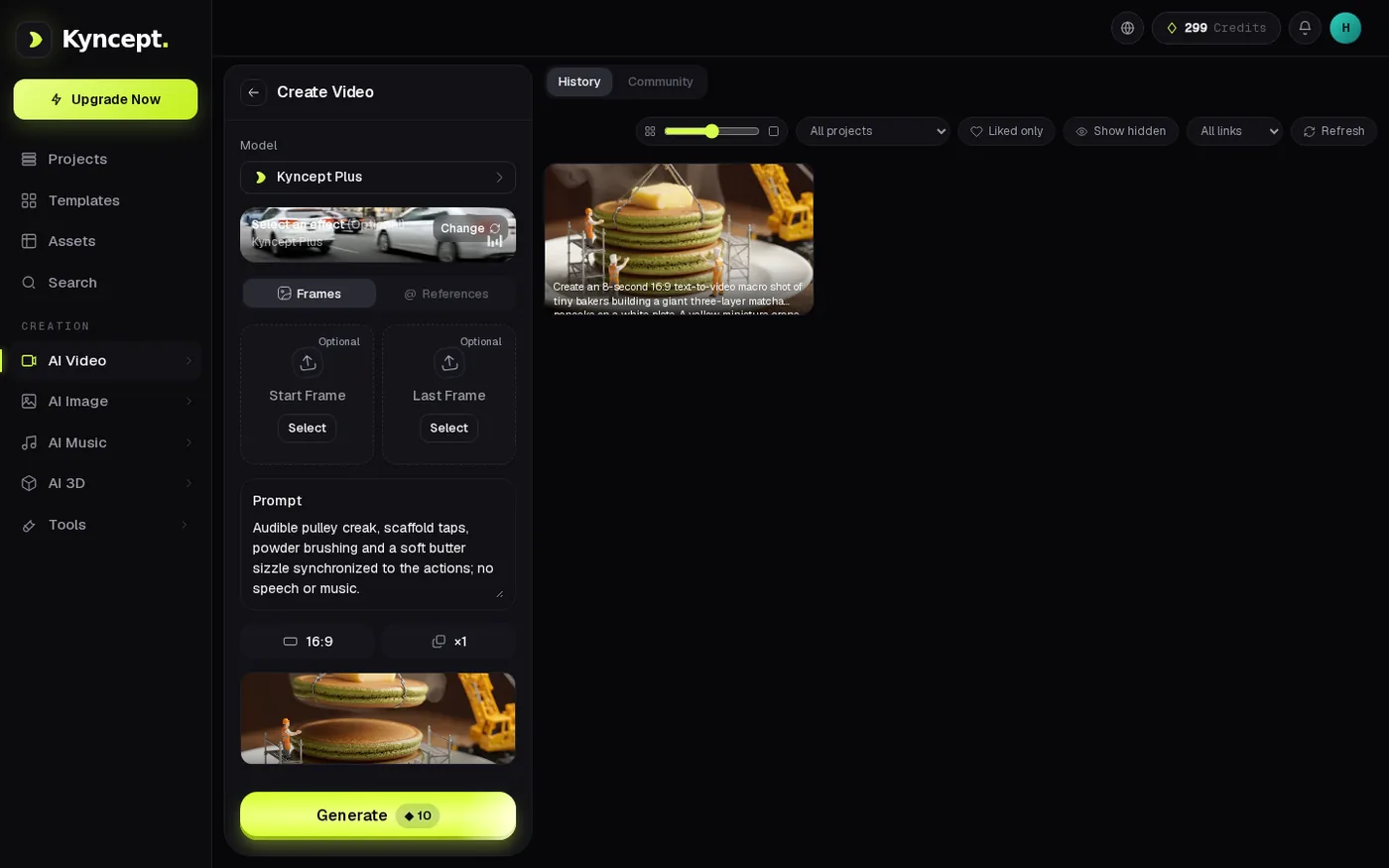
The first Kyncept result at 299 credits. The downloaded MP4 measures 8.000 seconds.
A second Kyncept render is different, not necessarily better
The second Kyncept run used the same text, debited 299 → 289 and completed in a measured 104.8 seconds on the UI. Its MP4 also runs 8.000 seconds at 1280×720, H.264 24 fps with AAC stereo; the file is 2,306,408 bytes and the audio peak is non-silent at −1.2 dB. The two Kyncept sequences are materially different, not a duplicated video counted twice. A frame-aligned SSIM reading of 0.460086 was used only to check duplication, never as a visual-quality score.
The second Kyncept frames show a giant human hand holding a brush. That departs from the requested miniature-world scale, much as Higgsfield's outsized brush and chef caps depart from parts of the brief. Kyncept delivered duration twice; that does not imply perfect prompt fidelity or a typical long-run success rate. The three video jobs here are a limited set of completed submissions, not a statistical benchmark.

Samples from the first Kyncept eight-second file. A montage is not a listening check or a full-motion review.
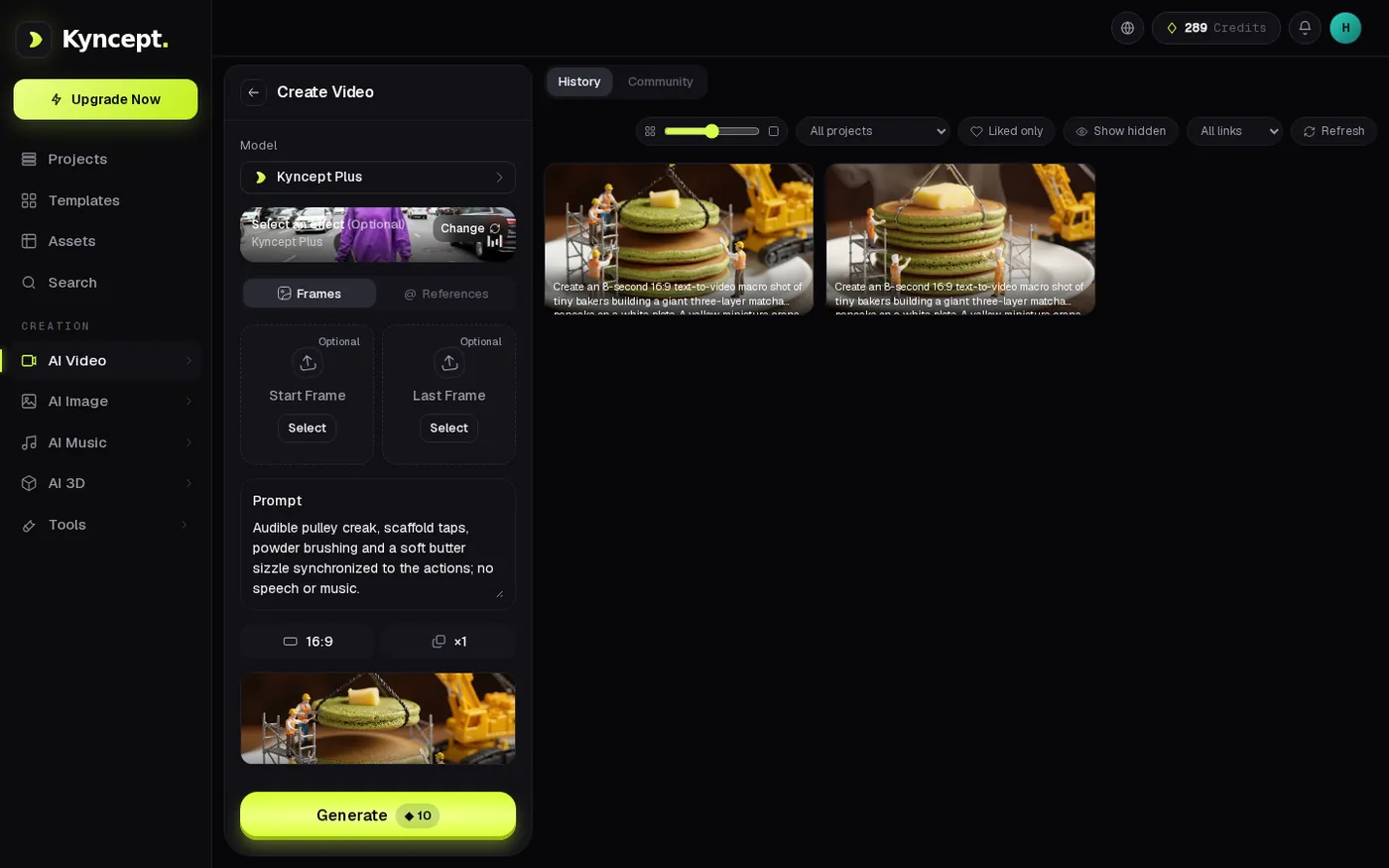
The second Kyncept result and 289-credit balance; this run has the measured 104.8-second UI time.

Samples from Kyncept video two show an outsized human hand with a brush. Eight seconds delivered does not mean every visual detail complied.
Does either soundtrack satisfy the Foley prompt?
Not verified. Higgsfield and both Kyncept files contain AAC stereo and non-silent measured peaks. Nobody in this test listened through and matched pulley creaks, scaffold taps, brushing and sizzling to the on-screen actions, or checked for speech and music. An audio stream might contain unrelated ambience; the highest measured level cannot identify it. The three peaks, −0.8, −9.2 and −1.2 dB, are level measurements, not quality rankings. Since Higgsfield and Kyncept files also differ in duration, an asserted synchronized-sound winner would compound two evidentiary mistakes. A creator promising ASMR to a client still needs to play and audit the original clips.
A nine-credit Higgsfield clip and a ten-credit Kyncept clip are unequal units
Nine Higgsfield credits bought this five-second video; ten Kyncept credits bought each eight-second video. Credits belong to separate companies and are not interchangeable. Nor were these jobs charged to matched paid subscriptions: the Higgsfield video was on one free account; Kyncept used its existing account. The distinct Higgsfield image free account, 10 → 8 → 6 across two stills, does not increase the remaining balance of the video account, 10 → 1.
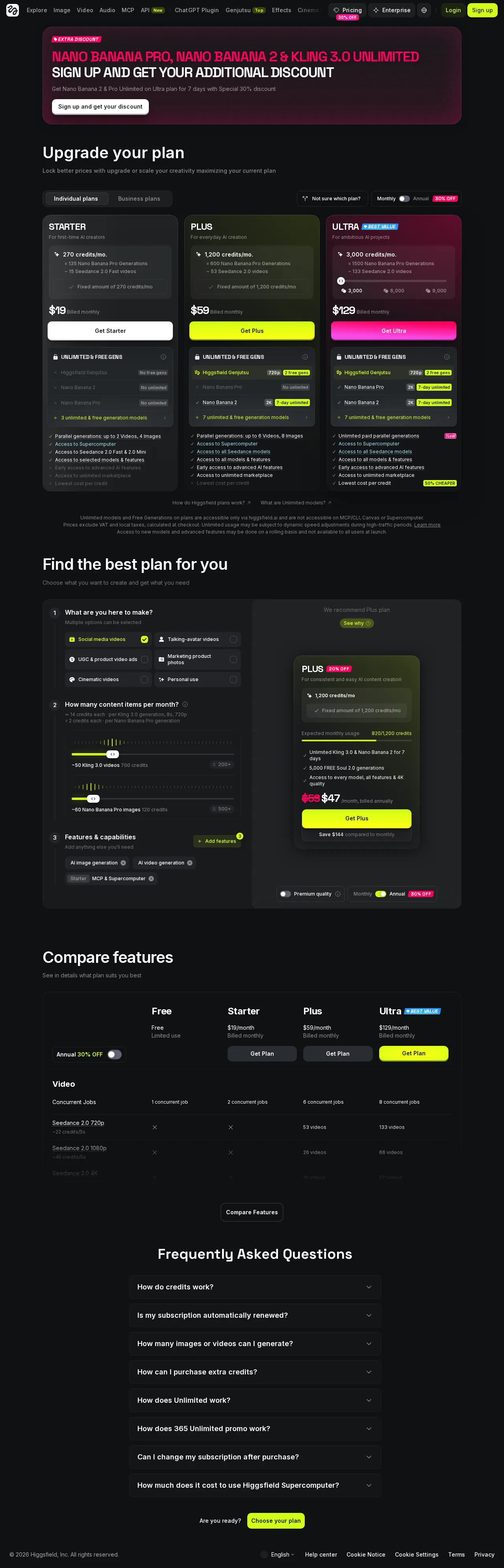
Monthly screenshots dated October 1, 2026 show a $59, 1,200-credit plan for each company, Higgsfield Plus and Kyncept Pro. This is a dated conditional illustration, not an October 2 price verification or a bill paid by these test accounts. On each company's own pictured plan, the observed video debits correspond to $0.4425 for Higgsfield's five seconds and approximately $0.4917 for Kyncept's eight seconds. Dividing whole-job debit by the selected nominal duration gives Higgsfield 9 ÷ 5 = 1.8 credits per second and Kyncept 10 ÷ 8 = 1.25. This is output accounting, not either provider's per-second billing rule or an equal-length price quote. For a fuller pricing breakdown, the separate pricing article below handles scenarios and limits.
Higgsfield Plus, $59 and 1,200 credits on the October 1 screenshot. No paid-plan charge occurred on the tested Higgsfield free account.
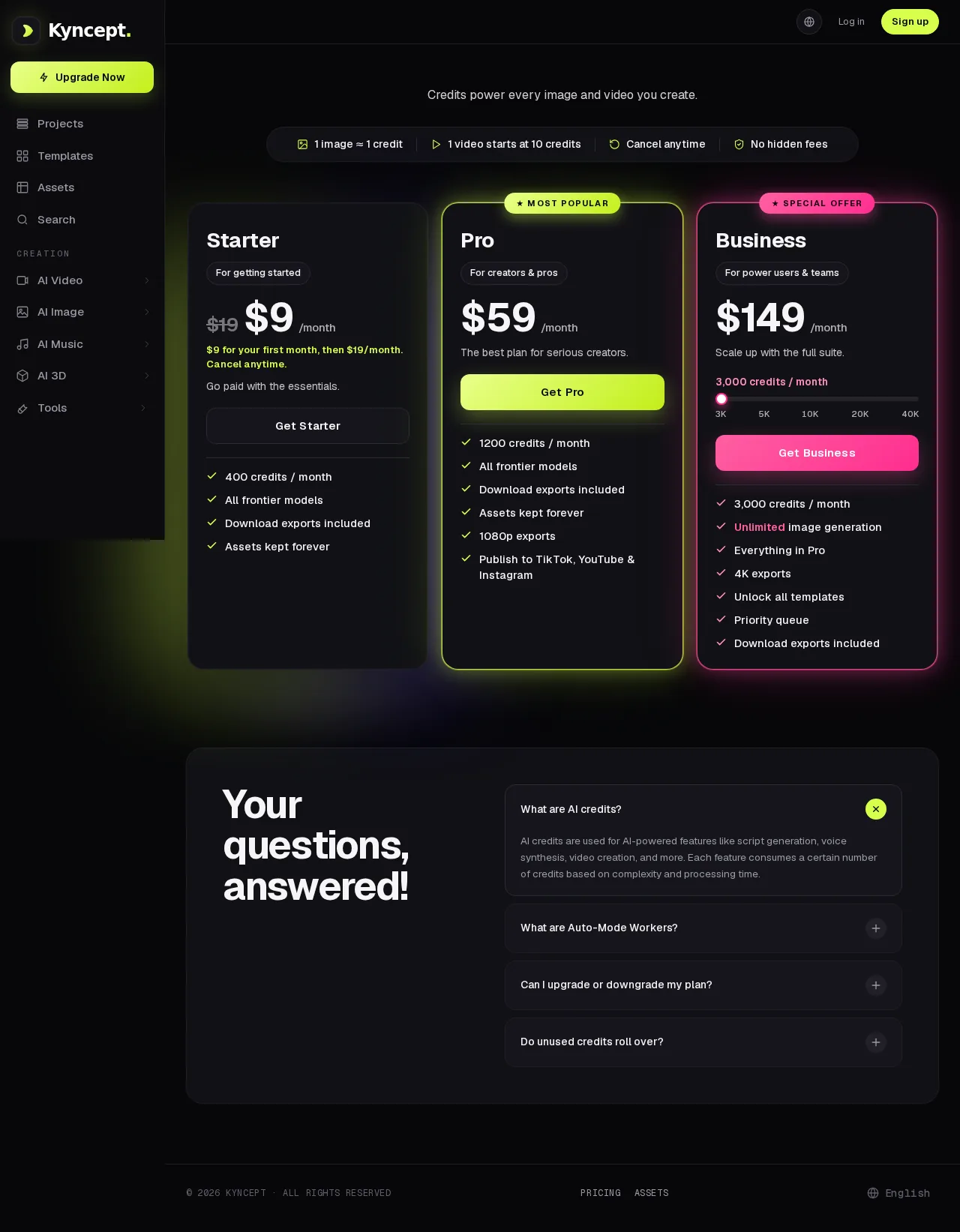
Kyncept Pro, separately shown at $59 and 1,200 credits on October 1. Neither plan's credits can be spent on the other platform.
Speed observations should not become a speed winner
Higgsfield's video was first observed within 127.05 seconds; Kyncept's second had a measured 104.8-second UI interval and its first has no valid interval. An upper bound and a measured interval cannot establish a speed winner. Two Higgsfield still results appeared within 22.61 and 45.82 seconds, versus Kyncept's measured 68.9 and 60.9 seconds. Higgsfield images appeared earlier here, but different clocks and a separate Higgsfield image account preclude an exact generation-speed ranking.
Where Higgsfield genuinely earns its place
Higgsfield did the first-timer's essential text-only job once on a free video account: one prompt, one completed clip, nine credits debited. The Higgsfield downloaded frame dimensions are larger than Kyncept's, even though Higgsfield's screen showed 720p selected; assess the moving originals at the intended viewing size rather than turn dimensions into a quality grade. The earlier-observed Higgsfield still images are another practical reason to try the platform when iterating a concept quickly, with the timing caveat above.
For the specific eight-second shot, Kyncept supplied two eight-second files where the selected Higgsfield route supplied one five-second file. Higgsfield's visual deviations and Kyncept's giant-hand intrusion both deserve inspection. No claim follows about every free Higgsfield mode, a paid eight-second setting, acoustic synchronization, rights, or repeatability. A short Higgsfield cutaway and a longer Kyncept scene serve different editorial needs.
Final verdict: Higgsfield delivered a clip, not eight seconds
Higgsfield produced a genuine 5.042-second, 1904×1104 H.264/AAC MP4 from text alone. Kyncept produced two different 8.000-second, 1280×720 H.264/AAC MP4s from the identical text. The tested Higgsfield control was set to five seconds; the eight-second wording in the prompt did not change that. Both sides have visual misses, and sound semantics remain unchecked. Higgsfield did not fail; the tested output lengths differ.
Scope: this is one tester's review of seven completed image/video jobs from October 1–2, 2026, not a statistically representative benchmark. The open questions are whether another Higgsfield mode could match eight seconds here, how any of the clips actually sound against the prompt, and whether repeated jobs would behave similarly. These files answer none of those broader questions.
Which one I would use for this job
When one text-only file must run eight seconds, I would first try Kyncept Plus based on these two completed examples, then inspect the motion and listen before delivery. If five seconds fits the edit, Higgsfield Wan 2.5 Fast is demonstrably viable in this test. Try the exact prompt at https://kyncept.com and compare the duration, actions, wallet debit and soundtrack against your own Higgsfield output. A single test cannot promise the next render will look or sound the same.
Originally published on Medium: Higgsfield AI Video Review 2026: 5 Seconds From an 8-Second Prompt.